Tuesday, March 27, 2007

Political Cartography


Politics play an important role in today’s society. With the 2008 presidential elections lurking around the corner, political campaigns are going full speed ahead. For any politician, understanding where the voters are geographically is important when designing an effective strategy for campaigning. It is also important for these politicians to know where the key voters are (minorities, farmers, big business etc.) so they can be sure to plan stops along their nation’s campaign tour. So basically, a smart politician is also somewhat aware of the cultural geography of America.
But these politicians weren’t born with this knowledge and it’s probably more than likely that they weren’t geography majors either. So how do they get and understand this information? With the help of cartography of course. Actually, to be more specific, political cartography. Once again we are back to the underlying theme of all my blogs that cartography is everywhere and involved with everything, even politics.
Political cartography consists of maps that help illustrate politics. For example, on the night of presidential elections, most news stations will have maps showing which states voted republican and which states voted democrat. Politicians running in races there after can look at these maps and see in what areas their party is traditional weak in and change their strategy accordingly. If a politician is struggling with minorities, he can do the same thing by looking at and interpreting maps. Maps can have a major influence on many things. Political maps not only help politicians, but they have many other uses as well. Political maps can be used in political cartoons as propaganda. They can also be used to gain support or visa versa before going to war. These maps have a lot of power and can be very influential towards whatever goals you seek to attain. Political maps are also used widely just to show land partitioning. These maps can help prove that certain areas are controlled by certain people. This helps when trying to pass legislation and laws pertaining to these kinds of things. In conclusion, political maps like any other maps have lots of uses and lots of power if used right.
Map provided by nationalatlas.gov

Friday, March 23, 2007

3-D Cartography


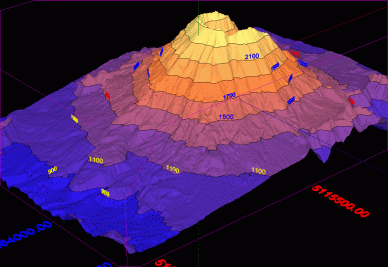
If you are an amateur map reader and your trying to learn about the topography of a certain area, understanding the map could come across as difficult. Without a good understanding of contour lines, elevation marks, and other symbols and features on a map, trying to get a good picture in your mind about the area you are about to explore is frustrating. After staring at this topographical map for just a few minutes, you probably wonder how much easier this map would be to use if it were three dimensional. It would be easier. Adding a 3rd dimension to the map not only makes the map look more exciting, but it also helps the viewer understand it easier.
In most cases, looking at a map that is three dimensional gives the map reader a completely different perspective. This three dimensional view allows the reader to see the map in a way most people could not of imagined while looking at the map in a traditional fashion. For instance, try looking at a topographical map. You probably see the contour lines marking elevation. While everything looks flat on the map, these lines are detailing elevation and are a representation of what the terrain actually looks like. To the untrained eye, this map could be hard to read. Now looking at this same map in a three dimensional format, even a person who has never looked at a map before could tell the differences in elevation and get a good understanding of the terrain.
Three dimensional cartography not only benefits the viewer of the maps, but the cartographers as well. This extra dimension allows cartographers to show their information many more ways and gives the purpose of their maps a whole different perspective. For instance, if you were trying to make a map of downtown New York City and the purpose of this map was to show people the height of each building, a two dimensional map would seem bland and would probably not grab the attention of your viewers. However, a three dimensional map would jump out at your viewers and give them a good idea about the height of each building and a comparison to the other buildings.
In conclusion, three dimensional maps are fun and interesting to look at. They can give any traditional map a new purpose and allow readers to better understand that purpose.
The three dimensional map of a volcano above is taken from http://3dfmaps.com

Tuesday, March 6, 2007

Old Map, New Map


Maps have influenced the world greatly. From the early history of man to today, maps have had a large part in the development of humans. The uses of maps continue to grow greatly as technology advances with time. In the past, only a select view were able to use maps but with newer technology and wider distribution, maps are being used by the media, and by society as a whole.
Maps have had a powerful impact throughout history helping with the civilization and development of humans. The earliest maps date back to the Stone Age and predate any form of written language by thousands of years. In fact, one of the oldest surviving maps is painted on a wall of the Catal Huyuk settlement in south central Turkey and is believed to have been painted around 6200 B.C. (Wikipedia). Throughout the early history of humans, many maps were made to show land plots and mining areas as well. For example, a clay tablet dating back to 3000 B.C. was found and contained a map showing a river valley between two hills. Cuneiform inscriptions, label features on the map which include a plot of land which is owned by a person called Azala. This map also contains markings that detail the cardinal direction. Maps drawn by the Egyptians were found that detail the mountains to the east of the Nile River where gold and silver were mined. These maps included descriptions of the mines, the shelters miners used, wells, and a road network that connected them all.
The purpose of modern maps isn’t much different than those used over 2,000 yrs ago. The only real difference is the technology used to make and view those maps. Maps are much the same now as in the past. People still use maps for land partitioning, city planning and even for mining just as they did in ancient Egypt. The fact that maps have lasted as long as they have is just proof that maps are important in any culture and that finding ways to make and improve maps is always a priority.
The map in the upper right corner of this blog is an old map of North America courtesy of the Ansari map library at the University of Nevada, Reno.